
Lets Be Honest…
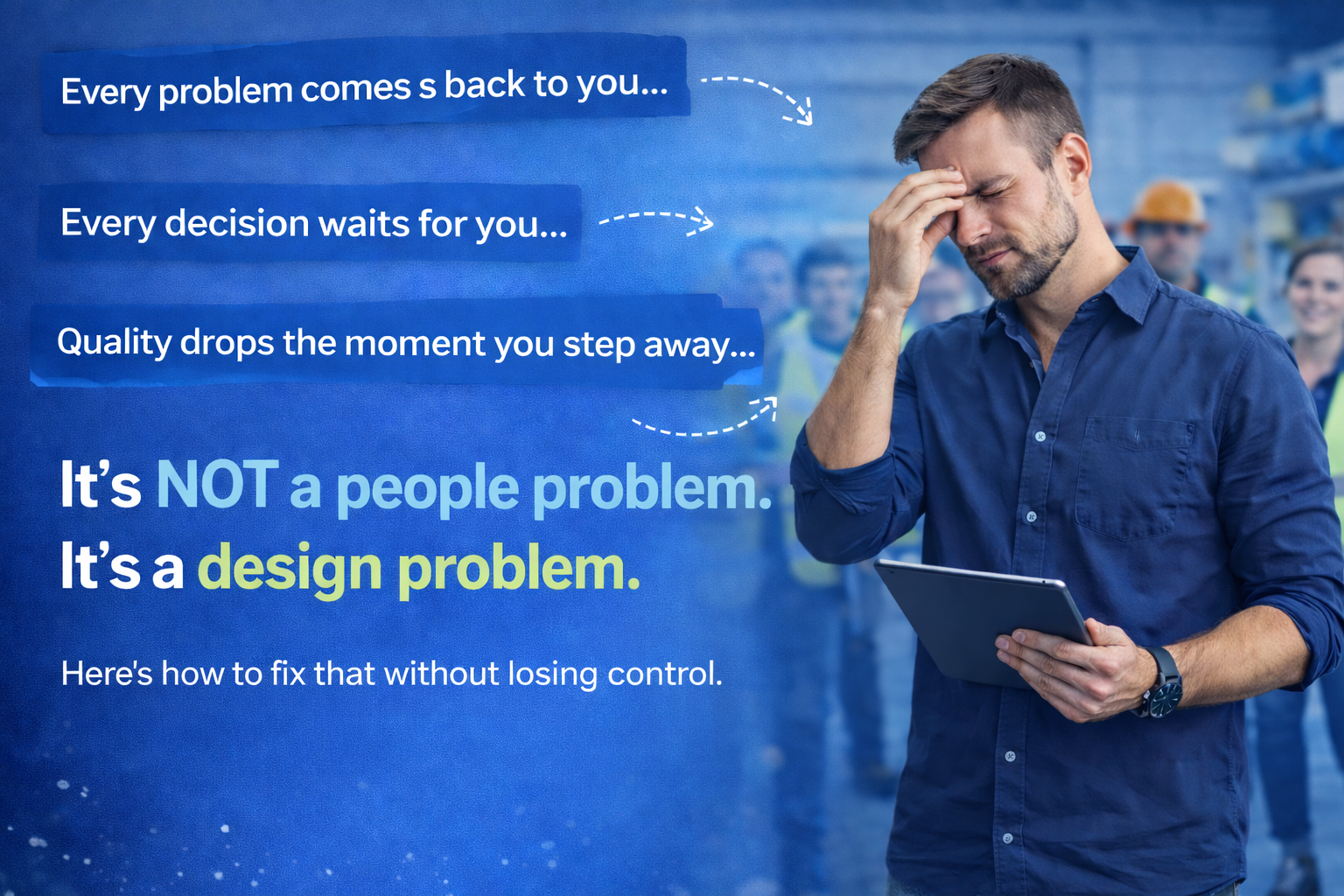
If every problem comes back to you…
If every decision waits for you…
If quality drops the moment, you step away…
It’s not a people problem. It’s a design problem.
Most trade and project-based businesses between $1M–$10M hit this wall.
Builders, electricians, plumbers, service operators, you’ve grown. You’ve hired. You’re busy.
But you’re still the glue. Here’s how to fix that without losing control.
Start with your Strategy - Visions | Mission | Values
If your team doesn’t know where the business is heading, they’ll default to asking you.
Clarity reduces dependency.
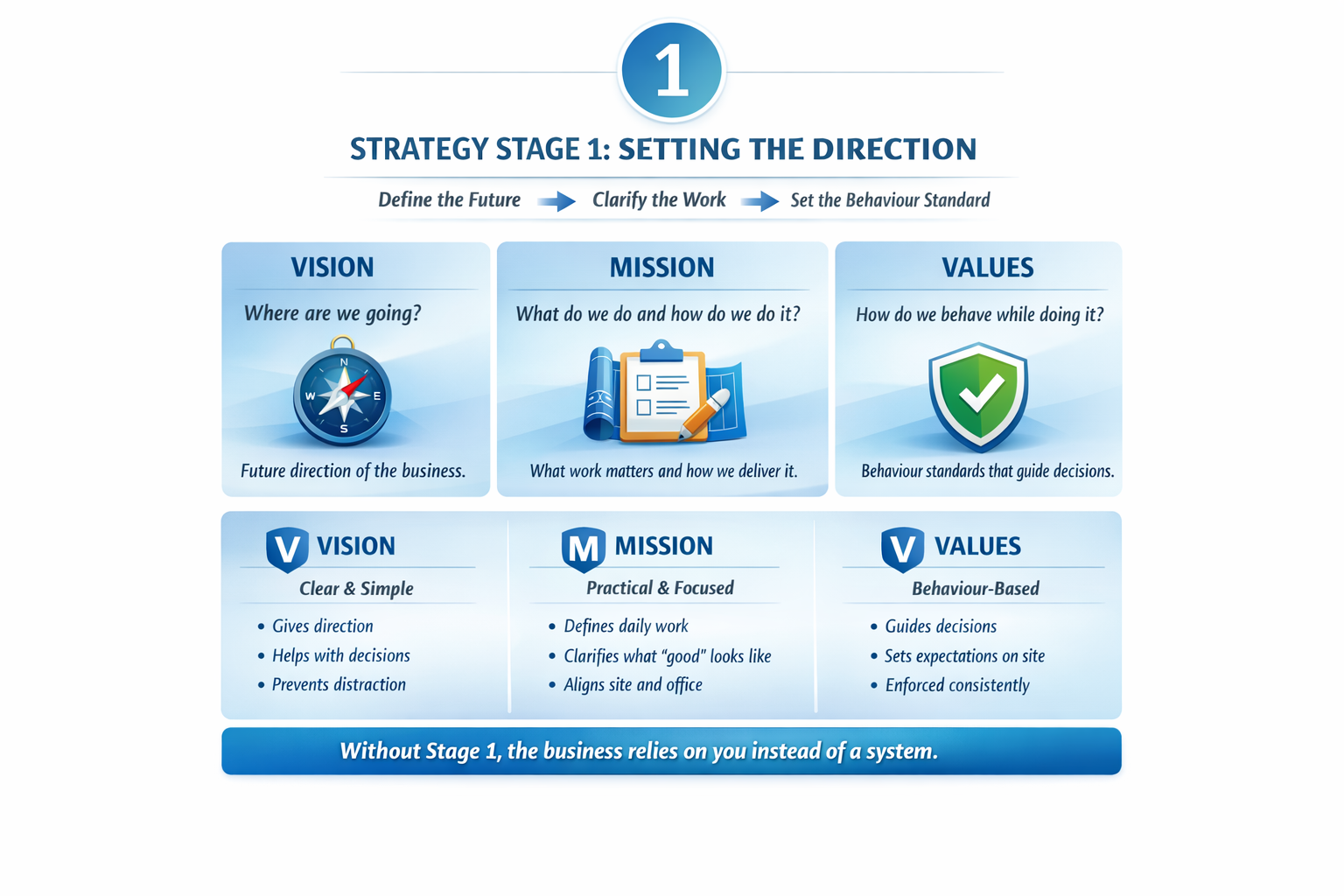
Srategy defines direction before action. It answers three questions:
Vision – Where are we going?
Mission – What do we do and how do we do it?
Values – How do we behave while doing it?
When the direction is clear, decisions align and dependency drops but without it, staff pull in different directions, and everything escalates back to you.
The Blocks to Building a Functional Team
A common myth is that org charts are for big companies.
Wrong.
When you’ve got 3–20 staff, clarity matters even more.
Everyone should know:
- Who owns site operations?
- Who owns scheduling?
- Who owns quality?
- Who owns client communication?
If ownership is vague, you become the default owner.
And that’s how dependency forms.
A job description isn’t a list of tasks.
It’s a definition of outcomes.
Every role should answer:
- What am I accountable for?
- What result am I measured on?
- What decisions can I make?
Ambiguity creates hesitation.
Hesitation creates escalation.
Escalation creates dependency.
If your team isn’t capable of operating without you, that’s not their fault.
It’s a development gap.
Most trade businesses train for technical skills only. But independence requires more:
- Commercial awareness (margin, costs, rework impact)
- Communication skills
- Planning ability
- Decision-making judgment
- Leadership behaviours
Autonomy without competence is risk.
Competence without autonomy is frustration.
If you want to step back, you must deliberately build people who can step up.
Autonomy only works when it’s clear.
You don’t need complicated frameworks. Keep it simple:
- What can they decide without asking?
- What needs a quick consult?
- What must come to you?
When decision rights are unclear, people play it safe and defer upward.
And here’s the key:
Autonomy only works when paired with psychological safety.
If someone is afraid of being blamed for mistakes, they won’t use their authority. They’ll escalate everything.
You want ownership not to fear.
Systems protect standards.
Process maps clarify how work flows.
Standard Operating Procedures (SOPs) reduce variation.
Quality Assurance (QA) checklists protect customer outcomes.
Checklists significantly reduce errors and rework, especially in high-pressure settings.
When quality depends on memory or experience alone, it depends on you.
When quality is embedded in process, it scales.
Structure without culture becomes rigid.
Culture without structure becomes chaotic.
Your values shouldn’t be words on a wall. They should define behaviour.
For example:
If you say “ownership” is a value, what does that mean?
- Do we fix mistakes without blame?
- Do we raise issues early?
- Do we finish what we start?
If you say “quality” matters:
- What’s acceptable?
- What’s not?
- What happens when standards slip?
Values reduce grey areas.
Behaviours reduce escalation.
When cultural expectations are clear, fewer problems land on your desk.
Even in small teams, leadership layers matter.
Who leads on-site?
Who mentors apprentices?
Who sets the standard when you’re not there?
If leadership equals “the owner,” you’ve built a single point of failure.
Leadership isn’t hierarchy. It’s responsibility and influence at all levels.
When others model the standard, you’re no longer the only reference point.
If performance isn’t visible, you’ll end up policing it.
Instead, make a few critical numbers visible:
- Projected Revenue & Gross Margin
- Rework lessons
- On-time completion
- Client satisfaction
- Safety incidents
When targets are clear and tracked, the team can self-correct.
Metrics reduce micromanagement.
You don’t need 20 dashboards. You need up to 5 meaningful indicators that align with your vision.
- Structure Even small teams need it
- Define Roles Design roles and accountability clearly
- Developing People Capability Development (This is a BIG one)
- Authority and Decisions Simple decision boundaries
- Mapping Process Maps, SOPs & QA Checklists
- Culture Culture, Values and Expected Behaviours
- Leadership Leadership beyond you
- Visibile Performance High-Level Metrics and Feedback Loops
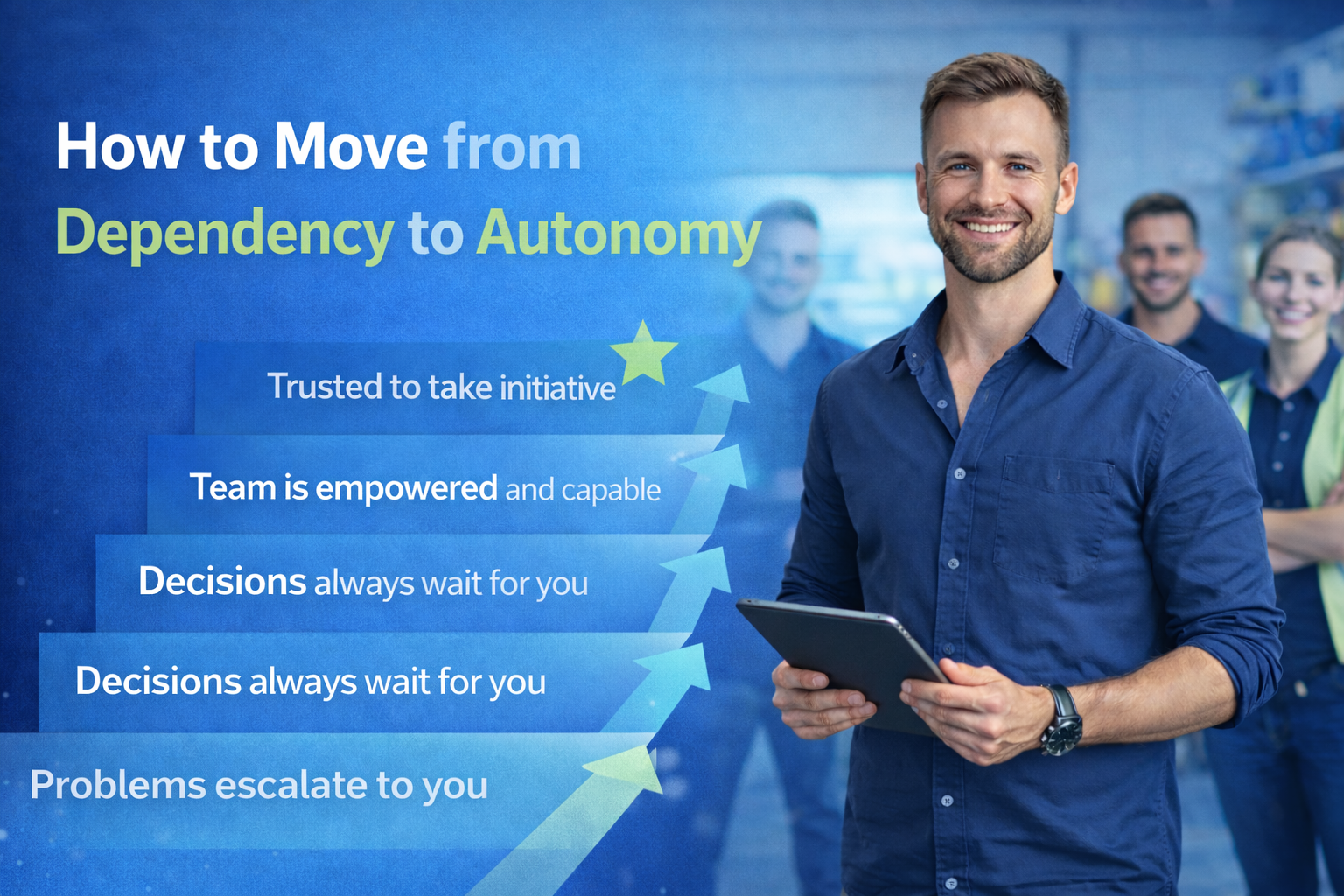
The Hard Truth
If you’re the bottleneck, it’s structural.
If quality drops without you, it’s capability.
If decisions always escalate, it’s authority clarity.
If standards slide, it’s cultural.
Dependency doesn’t happen because your team is lazy.
It happens because the business hasn’t been deliberately designed to operate without you.
“If your business depends on you, you don’t own a business — you own a job.”
— Michael Gerber
Build a Business That Works- Don't Carry It
If everything runs through you, it’s not a team.
It’s bottleneck.
Clear direction.
Defined structure.
Build capability.
Confident decision-making.
That’s how you remove yourself without losing control.
Ready to stop being the bottleneck?